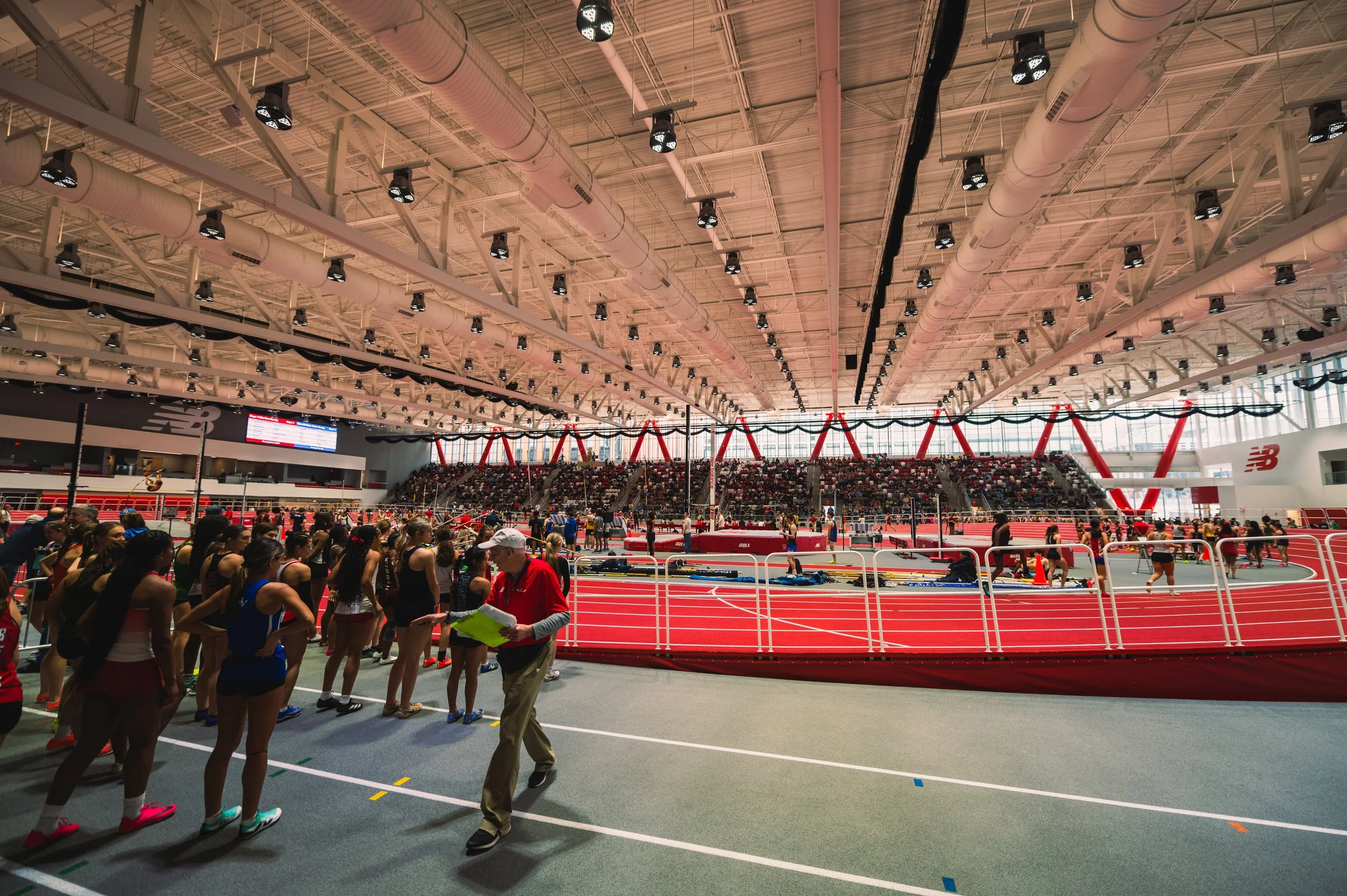
Rising Stars Youth Champs
Competition Rules
The Rising Stars Youth Championships will be conducted in accordance with USATF Youth Competition Rules, with the following meet-specific policies in place to promote athlete safety, competitive fairness, and efficient meet flow.
Meet management reserves the right to interpret and enforce all rules in the best interest of the competition and overall schedule.
Starting Blocks
Starting blocks are not permitted for athletes ages 12 and under in any event, including the 55m and 200m. These athletes must use a standing or crouch start without blocks.
Starting blocks are permitted for athletes ages 13-14 and 15–18 in sprint events. Use of blocks is optional and not required in either prelims or finals; athletes may choose to compete with or without blocks.
Meet management reserves the right to restrict block usage if necessary for safety or meet flow.
AWards
Top 8 individuals and top 8 relay teams will receive medals per event.
4x200m Relay
The 4x200m Relay will be conducted using a THREE-TURN stagger.
Per USATF Rule 218.1, a 20m Exchange zone will be used for all relays.
Event Limits
Athletes age 12 and under may compete in a maximum of three (3) events, including relays.
Athletes ages 13 through 18 may compete in a maximum of four (4) events, including relays.
Meet management reserves the right to remove athletes from excess events to maintain schedule integrity.
4x400m Relay
The 4x400m Relay will be conducted using a TWO-TURN stagger.
Per USATF Rule 218.1, a 20m Exchange zone will be used for all relays.
Field EVENTS
Heat Construction and Seeding
Sections may be seeded by time rather than strictly by age (particularly in the 800m, 1500m and 3000m).
Adjacent age groups may be combined for running purposes while scored and awarded separately by age.
Section sizes will be capped appropriately based on age group, event, and facility constraints.
Top 8 athletes within each division will advance to a final. If there are fewer than 8 athletes in a division and they are combined with another division, those athletes will be added to the final and receive another 3 jumps since they are considered top 8 in their division.
Long Jump Boards
8 and Under Boys and Girls: 2 feet
9 and 10 Year Old Boys and Girls: 4 feet
11 and 12 Year Old Boys and Girls: 6 feet
13 and 14 Year Old Boys and Girls: 8 feet
15 to 18 Year Old Boys and Girls: 10 feet
Shot Put Weights
8 and Under Boys and Girls: 2kg
9 thru 12 Year Old Boys and Girls: 6 pounds
13 and 14 Year Old Boys: 4kg
13 and 14 Year Old Girls: 6 pounds
15 to 18 Year Old Boys: 12 pounds
15 to 18 Year Old Girls: 4kg
Vertical Progressions and opening heights
High Jump progressions will be 5cm.
Boys and Girls Ages 9-14: Opening height = 0.85m
Boys Ages 15-18: Opening height = 1.30m
Girls Ages 15-18: Opening height = 1.20m
Pole Vault progressions will be 15cm with an opening height of 1.85m for both Boys and Girls
200m and 400m Dashes
All 200m/400m races will be conducted in lanes for all age groups. This policy is in place to ensure athlete safety, clean first turns, and consistent race flow.
Top 8 in 200m Prelims advance to the final.
Lane usage will not be modified except in exceptional circumstances at the discretion of meet management.
Protests
Protests concerning eligibility, rule interpretation, or meet procedures must be submitted to the Referee within 30 minutes of the posting of results.
All protests must be submitted in writing and accompanied by a $50 cash protest fee.
Judgment calls are not subject to protest. Decisions of the Jury of Appeals are final.
Starting Procedures
All sprint events (up to and including the 400m Dash) will be run in lanes. Alley starts will not be used.
Races 800m and longer will be run in alleys using a two-turn stagger.
55m Dash and 55m Hurdles
Athletes will be assigned lanes and sections for the 55m Dash and 55m Hurdles PRELIMS based on seeds coming into the competition. Preferred lanes are 4-5-3-6-2-7-1-8.
Top 8 athletes within each division will advance to a final.
If an age division does not have enough athletes to require a trial round, there will still be a final.
55m Hurdles will be conducted using five hurdles with the following hurdle heights:
11 and 12 Year Old Boys and Girls: 30 inches
13 and 14 Year Old Girls: 30 inches
13 and 14 Year Old Boys: 36 inches
15 to 18 Year Old Girls: 33 inches
15 to 18 Year Old Boys: 39 inches
Scratches and Check-In
Coaches and athletes are strongly encouraged to report scratches as early as possible.
Final heat assignments may not be published until the day prior to competition to account for scratches and no-shows.
Once heat sheets are finalized, empty lanes may remain and heats will not be reseeded on site except at the discretion of meet management.
Failure to check in by the designated deadline may result in being scratched from the event.
Equipment and Facility Rules
Only ¼-inch pyramid spikes or smaller are permitted.
All athletes must wear their assigned competition bib on the front of their uniform at all times during competition.
Lost bibs may be replaced for a fee.
Meet Management Authority
Meet management reserves the right to adjust heat sizes, combine or separate age groups, modify event order or timing, and make operational decisions necessary to ensure athlete safety and the timely completion of the meet.
RUNNING EVENTS